བྱ་རྒོད། / VULTURES
“We all face the same terror, the wound of mortality, the worm at the core of existence.” These words by psychiatrist Irvin D. Yalom draw inspiration from Ernest Becker’s groundbreaking book The Denial of Death (1973) and form the undertone of བྱ་རྒོད། / VULTURES, a new work by British-Chinese composer Jamie Man 文珮玲, commissioned by BL!NDMAN.
Our awareness of death is what binds us together as human beings, yet it is also something we are reluctant to confront. We prefer to avoid it, pushing it away into a realm of taboo. In doing so, we increasingly deny what we essentially are: mortal, vulnerable creatures.
In བྱ་རྒོད། / VULTURES, Jamie Man 文珮玲 brings life and death together on stage in the form of an auditory ritual, voiced through a drone speaker, vocal mantras, field recordings, animal sounds, saxophones and electronics.
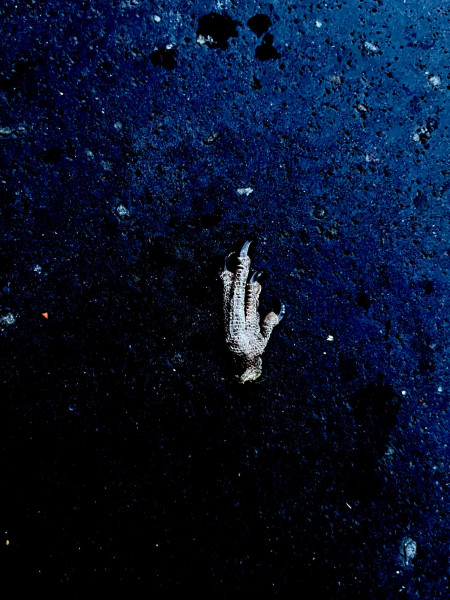
Inspired by ancient Tibetan practices, she stages a musical sky burial, a type of funerary rite in which the deceased are offered to vultures. The dead become nourishment for the living, and their souls continue to exist in the vultures that ascend into the heavens — a transfiguration that links humanity and nature. But the vultures required for sky burials are critically endangered. These Dakinis — Tibetan angels who guide the soul to the sky to await reincarnation — are themselves passing into death through mass extinction.
Jamie Man 文珮玲 and BL!NDMAN place the fragility of both humans and animals together on stage in the form of a musical meditation, symbolising the delicate connection between ourselves, death, and the natural world around us. The current state of global crisis permeates the performance. When reflecting on the loss of biodiversity, natural disasters, growing gender inequality, war and migration issues, society’s recognition of fragility becomes indispensable.
Building on the biopolitical reflections of thinkers such as Achille Mbembe, བྱ་རྒོད། / VULTURES re-evaluates our perception of decay, death and nature. With a critical eye on practices that seek to politicise life and death, Jamie Man 文珮玲 and BL!NDMAN draw inspiration from science philosopher Donna Haraway, who in her Cyborg Manifesto (1985) advocates the radical dismantling of rigid binary boundaries between human/animal, male/female and organism/machine.
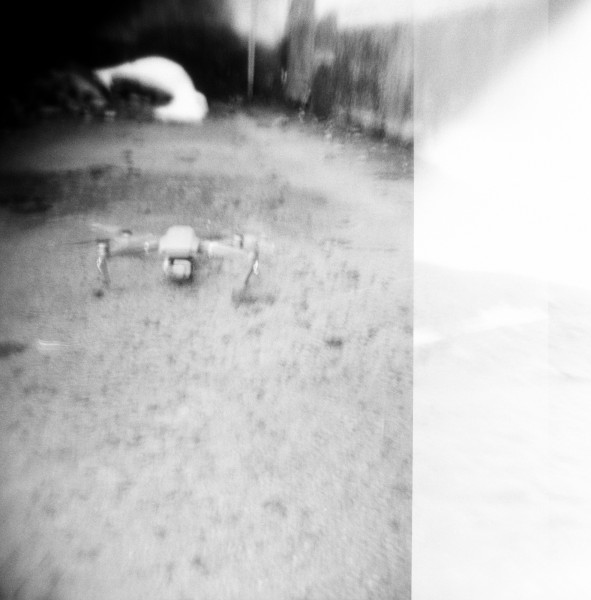
The use of a drone in a musical context is especially striking. Drones, which today serve in contexts of war both to destroy and to evacuate, take centre stage in this performance as embodiments of the endangered vultures. Drone technology — entwined with necropolitics yet also utilised in search-and-rescue operations — becomes a symbol of our paradoxical relationship with life and death.
བྱ་རྒོད། / VULTURES is a staging of a musical sky burial, dedicated to bodies in all forms who have lost their lives in current wars, climate disasters and asylum crises. It presents a chilling, polyphonic tableau that reminds us of our own mortality, mirrored by the feathered scavengers of the Old World.
Warning: This performance may contain nudity, shocking images and loud sounds.
Jamie Man 文珮玲 and Tomas Serrien: artistic direction and dramaturgy
Jamie Man 文珮玲: composition
BL!NDMAN [sax]
Pieter Pellens: soprano saxophone, electronics, loops, drone speakers
Hendrik Pellens: alto saxophone, electronics, loops, drone speakers
Piet Rebel: tenor saxophone, electronics, drone speakers
Sebastiaan Cooman: baritone saxophone, bass saxophone, loops, drone speakers
Thomas Demeyer: drone operator
Excerpts from “A Cyborg Manifesto” from the volume Manifestly Haraway by Donna J. Haraway and published by the University of Minnesota Press are used by permission. Copyright 2016 by Donna J. Haraway. All rights reserved.


Programme
5 movements
1. Last Breath
2. Clear Light
3. Chants
4. Vultures
5. Transmigration
Agenda

INTERVIEW
‘We’re turning a weapon of war into a musical instrument’
Four saxophonists, field recordings of Tibetan chants, electronics. And a drone fitted with speakers and a camera, circling the auditorium like a vulture. བྱ་རྒོད། / VULTURES practically demands an interview with composer Jamie Man 文珮玲 and Tomas Serrien of BL!NDMAN.
Whether there is life after death is a question that the greatest thinkers in history – from Goethe to Freek de Jonge – have wrestled with, so far without reaching an answer. But are you familiar with Tibetan sky burials? In these rituals, the body of the deceased is left to the vultures. What may seem macabre from a Western perspective provides the starting point for British-Chinese composer Jamie Man 文珮玲’s བྱ་རྒོད། / VULTURES, a new work commissioned by BL!NDMAN.
Man does not attempt to recreate this ancient practice in musical form. Instead, the sky burial becomes the starting point for a ritual centred on mortality, letting go and transformation. The line-up she has assembled is, to put it mildly, unusual: four saxophonists share the space with field recordings of Tibetan chants, electronics and a drone equipped with speakers and a camera, flying overhead.
What fascinates you about Tibetan sky burials?
Jamie Man 文珮玲: Sky burials have existed in Himalayan cultures for thousands of years. Tibetan Buddhists, specifically, believe that after a person takes their last breath, the consciousness attached to the body can still hear and the vocal chants which guide the consciousness through the multi-staged process of death come from the Tibetan ‘book of the dead’ the Bardo Thödol which literally translates to ‘The Great Liberation Through Hearing in the Intermediate State’. In the last stages of the process, the body is placed outdoors and eaten by vultures. This liberates the consciousness allowing it continue on towards its next rebirth. The vulture is the embodiment symbolically, spiritually and literally of ‘transmigration’ which I found completely extraordinary.
So you could say that བྱ་རྒོད། / VULTURES is about death, but about death as a new beginning. In our Western culture, which is heavily shaped by Christianity, we tend to hold on to the body and preserve it. In Tibetan Buddhism, by contrast, letting go is central: only by detaching, is the consciousness able to be liberated.
Tomas Serrien (BL!NDMAN): For many people in our society, the idea of an animal eating a human body feels strange – perhaps even repulsive. But in a sky burial there is a very strong connection between humans and nature.
Vultures are also regarded as angels. They carry the body up into the air and, in a sense, take it to another world. If you think about that for a while, there is something very beautiful about it.
In བྱ་རྒོད། / VULTURES, should the audience primarily listen to the sound, or is it important that they also understand the ideas behind it?
Tomas: That is something we ourselves have been grappling with throughout the creative process. What I find so compelling about Jamie’s work is that she can tell stories through music without spelling them out too literally. She uses sound, music and text in a poetic way, allowing each listener to take something personal from it.
It isn’t important to us that one particular message is conveyed. We live in a time when some things urgently need to be said clearly and directly, but the space for ambiguity is incredibly important. There is more need than ever for dialogue and nuance. Art doesn’t have to give people answers; it can offer a perspective from which they can question themselves and the world around them.
In your performance, a drone circles the space like a vulture. Does it almost become a character?
Tomas: What’s interesting about the drone is how quickly its symbolic meaning has changed. Fifteen years ago, we might have seen it primarily as a fascinating technological toy; today, we immediately associate it with the wars in Ukraine and other conflict zones. And yet it is still, in essence, a toy. The object itself has no intention: we are the ones who give it meaning.
That’s why I find it interesting to use the drone musically. Perhaps we can give it a different meaning again. We’re turning it back into a kind of toy – or a musical instrument.
A sky burial is very much about the connection between humans and nature. Isn’t a machine like that therefore a disruptive element?
Jamie: That’s for the audience to decide, although I’m not sure I would describe the drone itself as disruptive. You recognise it immediately, perhaps initially even as a gimmick, but through the music and the context it gradually takes on meaning.
Tomas: The connection with philosopher Donna Haraway is interesting here. In her Cyborg Manifesto, she challenges the very boundary between machine, nature and human. Technology may not necessarily change us physically, but it can challenge the way we see: how we look at one another and at the world. In that sense, the drone isn’t outside the world of བྱ་རྒོད། / VULTURES; it is part of it.
Haraway’s Cyborg Manifesto dates from 1985. In recent weeks, our relationship with technology has been thrown into turmoil once again: AI optimism has turned on its head in a very short space of time, with even fears of human extinction emerging. Has that changed the way you look at the work?
Jamie: All those post-apocalyptic philosophies about the end of the world are obviously fantastic for me: suddenly my work turns out to be relevant (laughs). But actually, these existential questions have been around for much longer. They keep appearing in different guises, but essentially they are the same.
Tomas: What AI makes particularly tangible, for example, is our fear of losing control. There is something of that in བྱ་རྒོད། / VULTURES too. Simply watching the drone can give you a sense of danger.
The drone is, of course, controlled by an operator, but symbolically it carries something unpredictable within it. That also makes me think of AI: people can be frightened of it, but as soon as they start working with it creatively, that fear can turn into fascination. New technologies have often provoked this kind of ambivalent response: Adorno, for instance, was similarly deeply suspicious of the radio.
The drone also carries a camera and a loudspeaker. This means the audience literally becomes part of the performance.
Jamie: We use live images of the audience. Just as the vultures look down at the people, at one point the audience finds itself looking at itself, bringing the idea of transmigration suddenly very close to home.
I’m very interested in ancient rituals precisely because they only survive when people actually experience and perform them. If nobody practises them any more, they disappear. That’s why the entire piece follows the form of a ritual. It isn’t about watching something being performed for you; it’s about being in the middle of it. We therefore move between the performance space and the audience – we try to break through that invisible wall.
So ultimately, བྱ་རྒོད། / VULTURES is more than a concert?
Tomas: For me, that’s an important question. Music theatre is traditionally understood as a combination of text, music and a performative element. But you can also use music itself to tell a story without relying on literal words.
In the West, we have also become accustomed to a very specific way of listening: you enter a concert hall, settle comfortably into the plush seats and listen to something taking place on a stage in front of you. With བྱ་རྒོད། / VULTURES, we want to break through that rather stale etiquette. This also connects with a more philosophical question that I want to explore further with BL!NDMAN: why do we still listen to music in such a conventional way?
De Bijloke is a particularly interesting place for this. The programmers are very conscious of the context in which we listen and of ways to make audiences aware that listening is about more than simply hearing. The space itself becomes part of the experience. So when we perform བྱ་རྒོད། / VULTURES elsewhere, it will become a different performance.
Jamie: For me, all these questions are connected: what is a composer? What is music? What does listening mean? We have to keep asking ourselves these questions, and I want to make work that also invites the audience to ask them.
My last mentor was Heiner Goebbels, who is both a composer and a theatre director. From that perspective, the boundaries between listening, watching and experiencing have become largely irrelevant to me. Writing a note that will sound in the dark is different from writing exactly the same note when I know it will sound under yellow light. Whether you call it a concert, an experience or a Gesamtkunstwerk makes little difference to me: those boundaries have long ceased to matter.
Jamie, on Instagram this summer you called for people to send you their new music, using the words: “the more woke, the better”. So how woke is བྱ་རྒོད། / VULTURES?
Jamie: བྱ་རྒོད། / VULTURES will probably be the wokest piece ever to have existed on this planet (laughs).
Joking aside, the original idea behind ‘woke’ – waking up – has almost completely disappeared by now. The word has been appropriated by the right and is often used as a term of abuse – so I use it rather cynically. For me, there is also an element of protest in that: reclaiming the word.
Bram Van Haelter